Staying active later in life is not about chasing personal records; it is about preserving the physical tools that make daily life easier. The numbers are clear: after age 50, adults can lose roughly 1% to 2% of muscle mass per year if they do not train it, and balance reactions tend to slow as well. The good news is that even a modest, consistent routine can produce measurable gains in strength, steadiness, and mobility within 6 to 12 weeks.
This guide focuses on low-impact exercises that are practical, repeatable, and scalable. You do not need an expensive gym setup to improve the skills that matter most: standing up from a chair, climbing stairs, carrying groceries, reaching overhead, and catching yourself if you trip. In many older adults, the biggest performance gains come not from intensity, but from frequency and consistency.
Why these three fitness pillars matter
Strength supports everyday tasks like lifting, rising, and walking longer distances. Balance helps reduce fall risk, which is especially important because falls remain one of the leading causes of injury among older adults. Mobility keeps joints moving through a useful range, which can reduce stiffness and make movement feel smoother and more efficient.
Think of the three as a triangle. If one side weakens, the others often compensate. For example, limited ankle mobility can affect balance, while weak hips can make walking less stable. Training all three together tends to deliver better results than focusing on only one category.
1. Chair stands
Chair stands are one of the best functional strength exercises for seniors because they mirror the movement pattern used dozens of times a day. They also require no equipment beyond a stable chair.
- How to do it: Sit tall in a sturdy chair with feet flat on the floor. Cross your arms over your chest or place your hands lightly on the chair arms if needed. Lean slightly forward and stand up slowly, then sit back down with control.
- Reps: 8 to 12 repetitions for 2 to 3 sets.
- Progression: Use a lower chair or slow the lowering phase to increase difficulty.
In testing for lower-body function, chair-rise ability is strongly associated with independence. If you can improve your sit-to-stand speed and control, you are likely improving the exact movement pattern that predicts day-to-day mobility.
2. Wall push-ups
Wall push-ups build upper-body and core strength without the joint stress of floor push-ups. They are especially useful for people who want to improve arm and chest strength for pushing doors, getting up from furniture, or stabilizing the torso during movement.
- How to do it: Stand facing a wall, about arm’s length away. Place hands on the wall at shoulder height and shoulder width. Bend your elbows to bring your chest toward the wall, then push back to the starting position.
- Reps: 8 to 15 repetitions for 2 to 3 sets.
- Progression: Step farther from the wall to increase resistance.
Because the body angle determines how much load you lift, a small change in foot position can noticeably increase the challenge. That makes wall push-ups a highly adjustable exercise for all fitness levels.
3. Heel-to-toe walking
This drill trains balance by narrowing your base of support. It is a simple but effective way to challenge the body’s stabilizing muscles and improve foot placement awareness.
- How to do it: Walk in a straight line, placing the heel of one foot directly in front of the toes of the other foot.
- Duration: 10 to 20 steps, repeated 2 to 4 times.
- Safety tip: Perform near a wall or countertop in case you need support.
Balance training works because the nervous system learns to make quicker corrections. Even if the movement looks small, the neuromuscular demand is real. Regular practice can improve confidence in walking on uneven ground or turning quickly.
4. Seated marching
Seated marching is useful for warming up, building hip flexor endurance, and encouraging circulation. It is also a low-risk starting point for people who find standing exercise difficult.
- How to do it: Sit upright in a chair and lift one knee at a time as if marching.
- Reps: 20 to 40 total marches.
- Progression: Add arm swings or increase lifting height while maintaining posture.
This movement may look simple, but it reinforces coordination between the hips and trunk. For many seniors, that coordination is a bigger limiter than raw muscle power.
5. Standing calf raises
The calves play a major role in walking, stair climbing, and maintaining balance during small shifts in body weight. Stronger calves can help with push-off power and postural control.
- How to do it: Stand behind a chair or countertop. Rise onto the balls of your feet, pause briefly at the top, then lower slowly.
- Reps: 10 to 15 repetitions for 2 to 3 sets.
- Progression: Perform one leg at a time if you can do so safely.
The slow lowering phase is especially valuable because it trains control. In movement terms, control often matters more than speed for reducing mishaps.
6. Side leg raises
Hip strength is closely tied to walking stability and fall prevention. Side leg raises target the muscles that help keep the pelvis steady when you move from one step to the next.
- How to do it: Stand tall while holding a chair. Lift one leg out to the side without leaning your torso, then return slowly.
- Reps: 10 to 15 repetitions per side.
- Progression: Add a light ankle weight only after you can complete the movement with good form.
Weak hip abductors can show up as a side-to-side wobble while walking. Strengthening them can improve efficiency and reduce compensations in the knees and lower back.
7. Ankle circles and ankle pumps
Mobility in the ankles affects walking mechanics more than many people realize. Limited ankle motion can alter stride length and make stairs feel harder.
- How to do it: While seated, lift one foot and rotate the ankle in circles. Follow with pointing and flexing the toes.
- Reps: 10 circles in each direction and 15 to 20 pumps per foot.
- Best time to do it: During a warm-up or after long periods of sitting.
This is a small exercise with a large payoff. Better ankle mobility often supports better walking rhythm and can make standing balance drills feel more controlled.
8. Gentle torso rotations
Spinal rotation helps with reaching, turning, and looking over the shoulder while walking or driving. A stiff torso can force the lower back and hips to overwork.
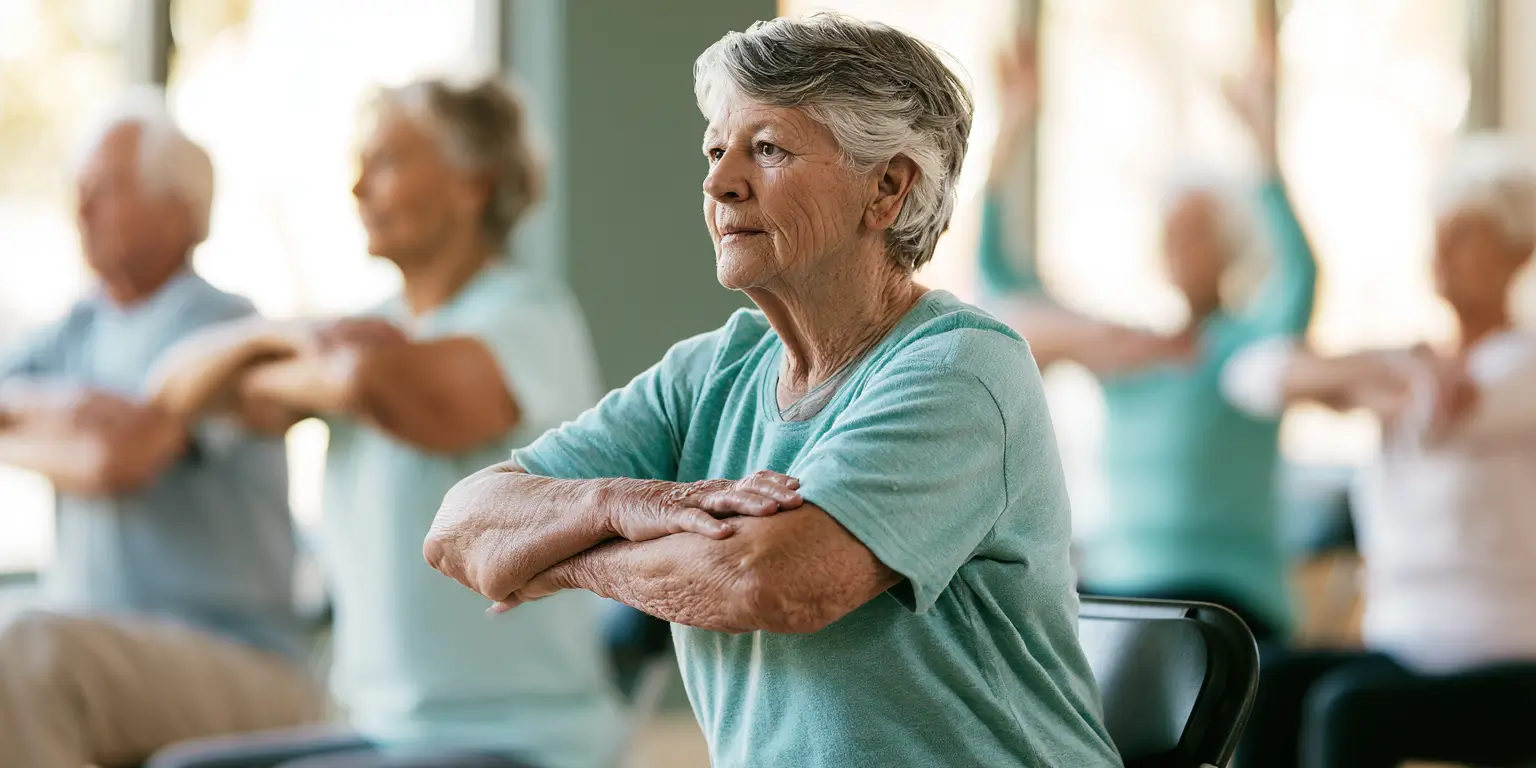
- How to do it: Sit or stand tall with arms crossed over the chest. Rotate the upper body slowly to one side, return to center, then rotate to the other side.
- Reps: 8 to 12 rotations per side.
- Progression: Pair the movement with controlled breathing.
Mobility work should feel smooth, not forced. If a movement creates sharp pain, reduce the range or stop and consult a professional.
A simple weekly plan
For most seniors, a balanced routine might look like this:
- Strength: Chair stands, wall push-ups, calf raises, side leg raises, 2 to 3 days per week
- Balance: Heel-to-toe walking, 3 to 5 days per week
- Mobility: Ankle circles, ankle pumps, torso rotations, daily
A practical session can take only 15 to 25 minutes. That is enough time to cover all three categories without overwhelming recovery. Even short sessions add up: three 20-minute workouts per week equals one full hour of targeted movement, which is far better than being inactive for seven straight days.
Tips for staying safe and consistent
- Use support: Keep a chair, wall, or countertop nearby during standing exercises.
- Move at a controlled pace: Avoid jerky motions, especially when balance is challenged.
- Start below your limit: Leave a few repetitions in reserve rather than training to fatigue.
- Track progress: Note how many chair stands or balance steps you complete each week.
- Consult a professional: If you have a history of falls, dizziness, joint replacement, or heart conditions, get guidance before starting.
The strongest fitness programs for older adults are not the most intense ones; they are the ones that can be repeated. With a small set of easy exercises and a realistic schedule, seniors can improve the physical qualities that matter most for independence. The statistical edge is simple: a little work done consistently beats a lot of effort done occasionally.