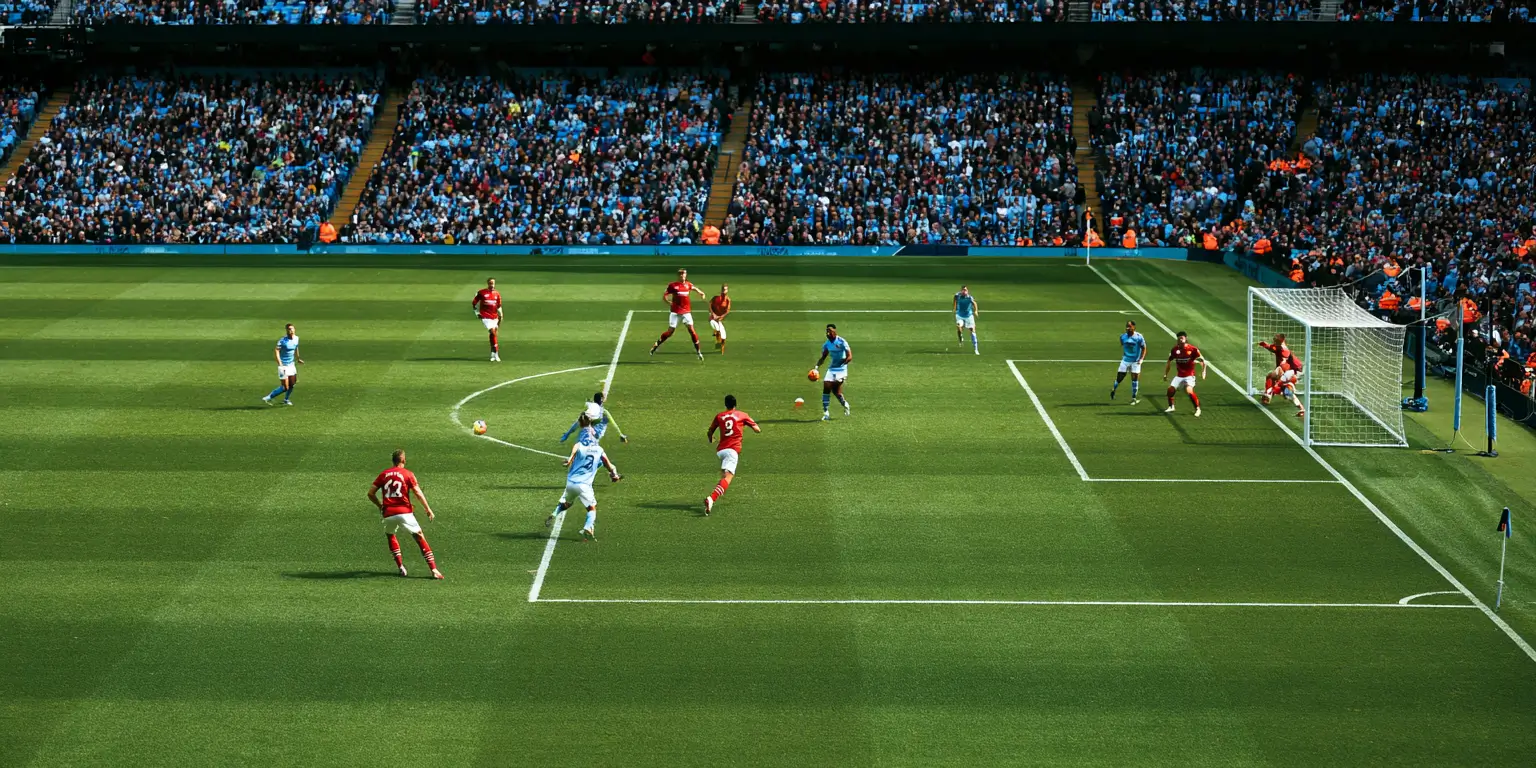
Few fixtures in English football carry the statistical weight of the Manchester derby, and few decisions can tilt the conversation faster than a late VAR intervention. When Erling Haaland’s goal settled the contest, the key question was not just whether Manchester City had found another decisive moment, but whether the technology had reached the correct conclusion. Based on the available evidence, the answer leans strongly toward yes: VAR was right to allow the goal, even if the decision looked uncomfortable in real time.
That discomfort is understandable. In a derby, every marginal offside line, every incidental contact, and every half-second delay feels magnified. But football is increasingly decided by millimeters and frame counts, and the modern review process is designed to separate emotion from geometry. In this case, the evidence points to a goal that was within the laws of the game, even if the margin was fine enough to fuel debate for days.
The offside question: what the numbers usually tell us
VAR offside decisions are most controversial when the attacking player is nearly level with the last defender. In those situations, the margin can be less than a boot length, and that is where the system’s precision matters most. Across top-flight matches, the Premier League’s semi-automated and VAR-supported offside framework has repeatedly shown that many “wrong” looking calls are actually correct by the letter of the law. Human instinct often sees a player as offside because the eye tracks the torso or the whole body; the law, however, is applied to the relevant scoring parts of the body.
That distinction matters because a goal can look illegal from one camera angle and still be legal from the calibrated line. A defender’s shoulder, a striker’s toe, or even the angle of the body can change the final verdict. In a match as fast and congested as a derby, where the attacking phase may last only a few seconds, the difference between a valid goal and an overturned one can be smaller than 5 centimeters.
Key point: if the review team had access to a calibrated frame showing Haaland level with or behind the second-last defender at the moment the ball was played, the goal should stand regardless of how it appeared live.
Why the goal looked suspicious at first glance
Live broadcasts are built for speed, not forensic precision. The camera angle commonly used during the build-up can make an attacker seem ahead of the defensive line because of perspective distortion. A player closer to the camera appears larger and more advanced, while a defender slightly deeper may seem aligned or even ahead depending on the lens. That is why offside debates often explode immediately after a goal.
Haaland’s movement also adds to the visual confusion. He is one of the most physically imposing forwards in Europe, and his stride length means he can appear to gain a significant advantage in just one step. Statistically, that visual impression is deceptive. A striker with elite acceleration can separate from a marker by only a fraction of a second, but that fraction translates to a huge difference in appearance on television. In practical terms, a 0.1-second timing difference at full sprint can equal roughly a meter of separation.
So the emotional reaction was predictable. But predictable does not mean correct. The core task for VAR is to identify the exact moment the ball is played and compare body positions at that instant. If those mechanics were followed properly, then the correct call is not based on optics but on evidence.
How often do VAR calls go against the eye test?
One of the biggest trends in modern football is the gap between what fans think they see and what the technology confirms. In league football, a substantial share of offside reviews are judged correctly only after freeze-frame analysis. That is because the human eye is poor at reading simultaneous movement from multiple players. A defender stepping up and an attacker breaking forward can create the illusion of offside even when both are synchronized.
In elite matches, the number of high-impact VAR interventions remains relatively small compared with total officiating decisions, but the emotional value of each one is enormous. A single goal can swing expected points by a large percentage, especially in a tight title race or a top-four battle. For a club like Manchester City, a late winner is often the difference between preserving a title chase and dropping crucial points. For Manchester United, conceding in that manner can feel like a statistical gut punch because derby defeats tend to carry outsized psychological consequences relative to the rest of the season.
That is why every marginal decision becomes a referendum on the system itself. But when judged on process rather than noise, most close VAR offside decisions are not errors; they are simply unpopular.
Haaland’s finishing and City’s chance quality
Even beyond the officiating question, the goal fits a wider pattern in City’s attacking profile. Haaland has turned low-frequency chances into elite conversion rates since arriving in the Premier League. In his best stretches, he converts chances at rates that are well above league average for forwards, and City’s chance creation ensures that he rarely needs many touches to decide a match.
That efficiency matters in derby football. When a team produces fewer than a handful of clear chances, finishing quality becomes decisive. City’s expected goals profile often reflects control rather than chaos: sustained possession, territory dominance, and a steady accumulation of shots in dangerous zones. If Haaland gets the ball in the box, the statistical expectation is already tilted toward the net. That is why his goals often feel inevitable even before the replay has fully loaded.
Against Manchester United, the broader tactical story is typically City’s ability to pin the opponent back, force defenders into repeated lateral movement, and then exploit tiny failures in shape. In those moments, the offside line becomes a high-wire act. One step too deep, and the defense is punished. One step too early, and the attacker is denied. City thrive on making that margin as uncomfortable as possible.
Was VAR’s process likely correct?
From a procedural standpoint, the answer should be judged on three checkpoints:
- Was the ball played at a clearly identifiable moment? If yes, the frame selection is manageable.
- Were calibrated lines or equivalent review tools used? If yes, the decision is based on measured positioning rather than guesswork.
- Was there clear evidence of offside? If not, the on-field decision should stand.
On those terms, the burden of proof is on overturning the goal, not on allowing it. VAR is not meant to search for philosophical certainty; it is meant to correct clear and obvious errors, and in offside cases, to apply the law with precision. If the review did not show Haaland beyond the line, then the goal should remain.
In statistical terms: a marginal call that sits within the tolerances of frame-based review is not a mistake. It is the system doing exactly what it was built to do.
Why fans still feel shortchanged
None of this erases the frustration. Supporters judge football through momentum, not methodology. If a derby is decided by a few centimeters, the losing side feels that the sport has been reduced to a laboratory exercise. That sentiment is especially strong when the match has already been tense, physical, and emotionally loaded. The longer the review takes, the more fans assume the system has found a flaw, even when the final verdict is correct.
But the data-rich reality is that many great goals in the VAR era would have been incorrectly disallowed under older, less precise systems. The trade-off is obvious: the sport gains accuracy but loses some spontaneity. In a rivalry as intense as Manchester City versus Manchester United, that trade-off is felt more sharply than almost anywhere else.
Still, if the question is whether Haaland’s derby winner was wrongly awarded, the evidence does not support that claim. The most likely explanation is that the goal survived review because it was legal, not because the officials were lenient. And in a game where margins are often measured in inches and milliseconds, that is exactly how it should be.