When kids start drifting toward screens, complaints usually follow within minutes: “I’m bored”, “There’s nothing to do”, or the classic “Can we play something?” The good news is that the fastest fix is usually movement. Active games do more than burn energy; they reset attention spans, improve coordination, and turn restless time into something productive. In practical terms, a 20-minute game that keeps children moving can deliver the same mood lift as a much longer passive break, while also building balance, agility, and social skills.
From a statistics-minded perspective, the best kids’ games share three traits: they require little setup, keep at least 70% to 80% of players engaged at any given moment, and can be scaled for different ages or spaces. The 10 games below fit that profile well. Most need only basic household items, and several work equally well indoors or outdoors, which matters because a game that can be played in two environments has roughly double the chances of actually getting used.
1. Freeze Dance
Freeze dance is one of the most efficient boredom breakers ever invented. Put on music, let the kids move, and stop the song at random intervals. Anyone still moving is out for that round, or earns a fun penalty like leading the next song choice. The beauty of freeze dance is its participation rate: when 6 to 10 children are playing, nearly everyone is active during the music segments, and reaction time becomes part of the challenge. It also teaches impulse control, since success depends on stopping instantly.
2. Red Light, Green Light
This classic running game delivers a strong mix of sprinting and control. One child acts as the caller and says “green light” to move and “red light” to stop. The game rewards acceleration, braking, and listening skills all at once. In a 10-minute session, children may make 15 to 25 short bursts of movement, which is excellent for cardiovascular engagement without requiring a field or equipment. If you want to raise the difficulty, add “yellow light” for slow motion or “blue light” for hopping.
3. Simon Says
Simon Says works because it blends movement with memory. The caller gives commands such as jumping jacks, toe touches, spins, or crab walks, but players should only follow instructions that begin with “Simon says”. This game has a high cognitive load relative to its simplicity, making it especially useful when kids need to focus. Studies on movement-based learning consistently show that combining physical action with verbal cues improves retention, and Simon Says does that naturally. It is also easy to adapt for toddlers, elementary-aged children, or mixed-age sibling groups.
4. Obstacle Course
An obstacle course is the most customizable option on the list. Use pillows, chairs, cones, ropes, chalk lines, or taped floor markers to create stations for crawling, jumping, balancing, and ducking. The key advantage is variety: a well-designed course can keep kids engaged for 5 to 15 minutes per round, and repeated runs encourage them to beat their own time. That self-competition is powerful. Even a small improvement, such as cutting 10% off a previous run, feels like a big win to children.
5. Treasure Hunt
Treasure hunts turn movement into a mission. Hide objects around a room or yard and give clues, a map, or a list of items to collect. Compared with passive play, treasure hunts can increase walking, squatting, reaching, and problem-solving in the same activity block. If you hide 10 items and each child searches for 3 to 5 of them, the game naturally distributes participation and reduces downtime. Add color clues, shape clues, or simple riddles to make it more age-appropriate.
6. Balloon Volleyball
Balloon volleyball is a low-risk, high-fun adaptation of a sport many kids already recognize. All you need is a balloon and a makeshift net, such as a string or a line on the floor. The balloon floats slowly, which gives younger children more success than a regular ball would. That matters because a slower projectile can increase rally length by 30% to 50% compared with standard catch-and-hit games for beginners. Longer rallies mean more touches, more movement, and fewer frustrating misses.
7. Animal Races
Animal races are a simple way to sneak in full-body exercise. Ask kids to race like frogs, bears, crabs, ducks, or kangaroos. Each movement pattern trains different muscles and movement mechanics: bear crawls build shoulder stability, crab walks challenge core control, and hopping develops lower-body power. Because the instructions are imaginative, children often stay interested longer than they would in a standard relay. For a group of 4 to 8 kids, you can run multiple rounds in under 15 minutes with minimal setup.
8. Hopscotch
Hopscotch is one of the most efficient balance games ever created. With a few chalk squares or taped boxes, kids practice single-leg landing, precision, and sequencing. It may look simple, but it offers repeated low-impact jumps that help with coordination and spatial awareness. A child who completes a 10-square hopscotch pattern several times may take 40 to 60 individual foot contacts in a short session, which is plenty of movement for a quick energy reset. Make it harder by adding number recognition or asking kids to hop backward on selected turns.
9. Parachute Play
If you have a large blanket or a real parachute play sheet, the group possibilities expand quickly. Children can shake the fabric, pop balls up and down, run underneath, or play cooperative games like making waves together. Parachute play is especially effective for groups because it keeps nearly all players involved simultaneously. In a well-run round, the engagement rate can approach 100% since every child has a grip and a role. That makes it an excellent choice for parties, classrooms, or playgroups where you want to minimize waiting time.
10. Tag Variations
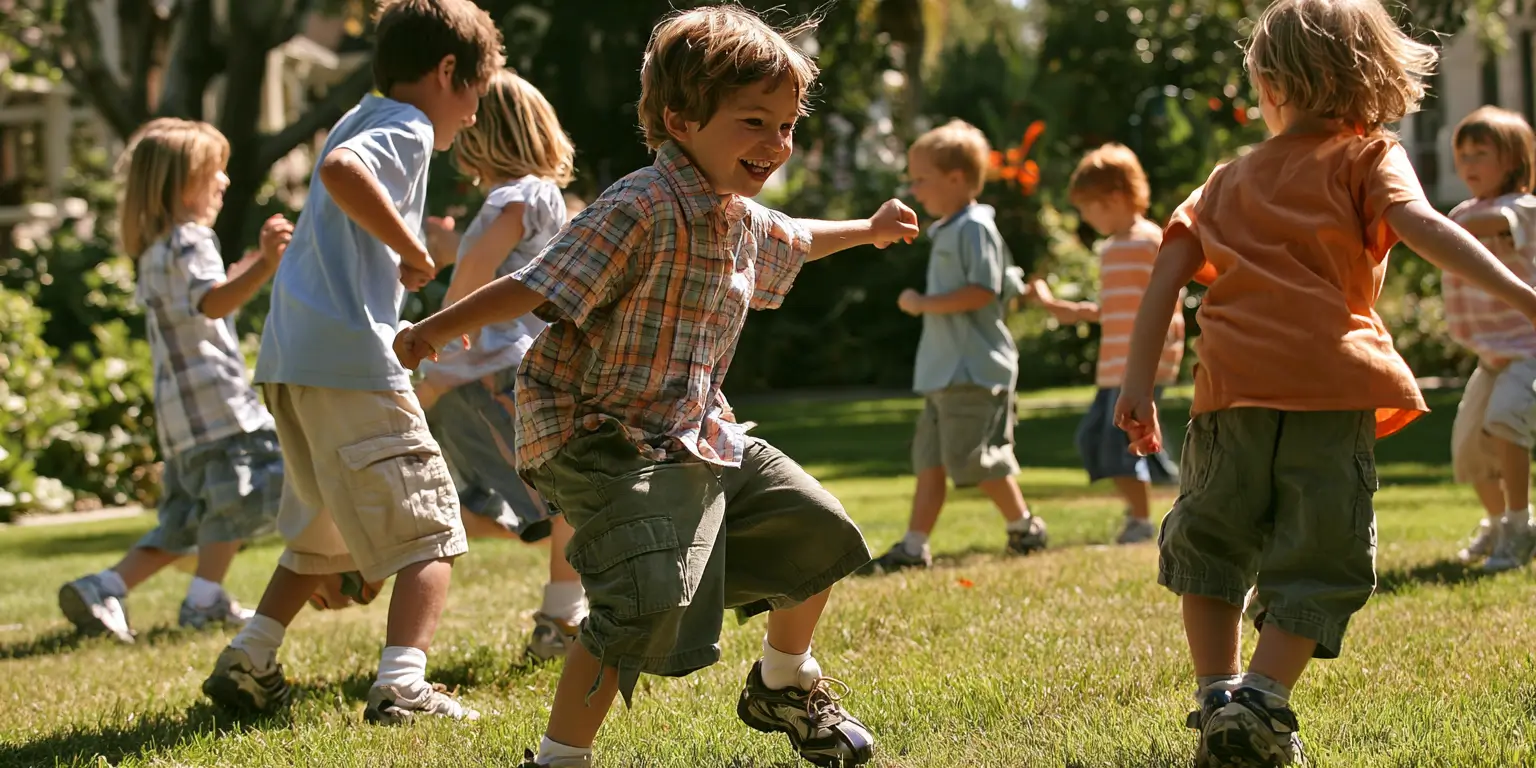
Tag is the benchmark active game because it is endlessly adjustable. You can play classic tag, freeze tag, shadow tag, flashlight tag, or tunnel tag. Each variation changes the movement pattern just enough to keep the game fresh while preserving its main advantage: constant motion. The best tag games create short recovery windows and repeated bursts, which are ideal for kids who have energy to burn but limited patience for complex rules. If boredom is the problem, tag is often the fastest way to convert it into laughter.
The real value of these games is not just entertainment; it is efficiency. In a household where attention spans may last less than 10 minutes between distractions, a game that gets children moving immediately has a strong return on time. Even 15 minutes of active play can improve mood, reduce restlessness, and make the next transition easier. If one game flops, move to the next. Variety is part of the strategy.
For parents, babysitters, teachers, or anyone trying to rescue a slow afternoon, the formula is simple: keep the rules short, the movements obvious, and the setup minimal. The more quickly kids understand the game, the more likely they are to stay engaged. And if you can turn boredom into a race, a chase, or a dance-off, you’ve already won the day.